
What Are Salesforce Record Types?
Salesforce record types are a foundational configuration capability in Salesforce that allows organizations to structure, separate, and control how different Salesforce object records behave within the same object. In real business environments, they are one of the most practical tools for achieving clean CRM organization without duplicating data models or creating unnecessary system complexity. In many implementations, teams working on Salesforce development solutions use record types as a core design element to build scalable and maintainable CRM solutions.
At a basic level, Salesforce record types define variations of the same object. That means a single object like Opportunity, Case, or Lead can behave differently depending on the business context. This is essential when organizations run multiple Salesforce business processes inside one CRM system.
For example, a company may have one sales process for new customers, another for renewals, and another for upsell opportunities. Instead of creating three separate objects, Salesforce record types allow all three workflows to exist under one structure while still maintaining separation. This directly improves Salesforce data organization and reduces long-term maintenance overhead.
From a CRM architecture perspective, Salesforce record types are used for CRM record categorization. They ensure that users only interact with relevant fields, workflows, and picklist values based on their role and process type. This reduces confusion and supports better Salesforce record management across departments.
They are also a core mechanism for Salesforce process segmentation, which means breaking down complex business operations into structured, manageable workflows inside a unified system. Without this capability, organizations would struggle to maintain consistency across teams.
In practical implementations, record types also influence page layouts, user profiles, and business logic. This makes them central to business process management because they determine how users interact with data on a daily basis.
Definition of Record Types
Salesforce record types define different variations of the same object, allowing organizations to apply unique business rules, page layouts, and picklist values based on process requirements. This enables structured CRM organization and improves workflow alignment across departments.
Why Salesforce Uses Record Types
Salesforce uses record types to solve a common enterprise problem: multiple teams using the same object but requiring different workflows. Without record types in Salesforce, businesses would be forced into a single rigid structure that does not reflect real operational needs.
Record types help separate business processes while maintaining a unified data model. This improves Salesforce data organization and reduces duplication across the system.
They also support scalability by allowing new processes to be added without redesigning the entire CRM structure.
Relationship Between Objects and Record Types
To understand how Salesforce record types work, it is important to understand the relationship between objects and record types.
Salesforce object records act as the foundation of the CRM database. They store raw business data such as accounts, opportunities, and cases. Record types sit on top of this structure and determine how that data behaves depending on context.
This relationship allows organizations to maintain a single data structure while still enabling CRM record categorization. Instead of creating multiple objects for every workflow, businesses can reuse existing objects and apply record types to differentiate behavior.
This improves Salesforce record management and ensures long-term system stability.
How Salesforce Record Types Support Business Processes
Salesforce record types are directly tied to Salesforce business processes because they define how workflows are structured inside the system.
Each record type can have its own:
- Business process stages
- Page layouts
- Picklist values
- Validation rules
This means organizations can standardize workflows while still allowing flexibility for different teams.
For example, a service organization may have different case types such as technical support, billing inquiries, and account issues. Each of these requires different handling. Salesforce record types allow each workflow to exist independently while still being part of the same object.
This improves operational efficiency and ensures workflow alignment across departments.
It also reduces process confusion because users only see what is relevant to their specific role.
Common Use Cases Across Organizations
In real-world CRM implementations, Salesforce record types examples are found across almost every industry.
Sales organizations use them to separate new business deals from renewals and expansions. Service teams use them to distinguish between different types of support cases. Operations teams use them to manage internal requests and vendor workflows.
These use cases show how record types improve CRM record categorization and support structured Salesforce business processes.
They also play a key role in improving Salesforce data organization by ensuring that data is consistently classified at the point of entry.
Key Components Associated With Salesforce Record Types
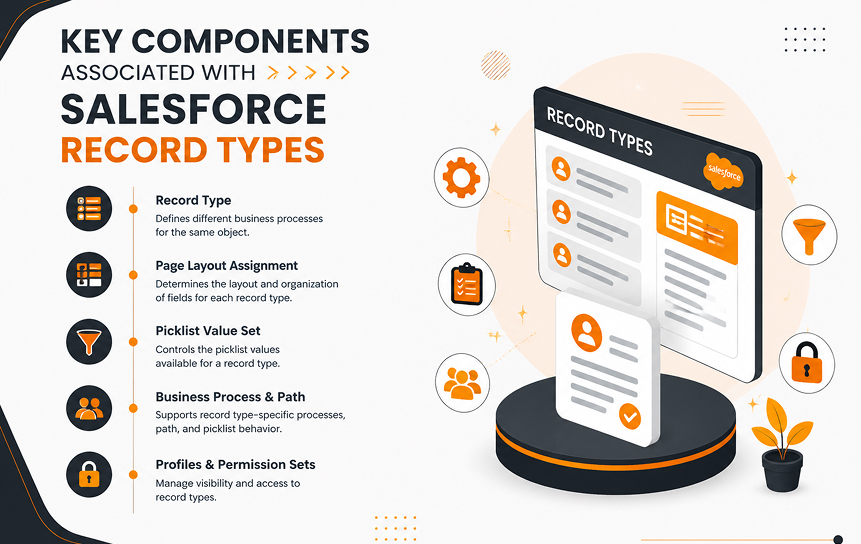
Salesforce record types do not operate alone. They are part of a larger ecosystem of configuration tools that define how users interact with CRM data.
One of the most important components is page layouts. Page layouts control how fields are displayed on the screen, while record types determine which layout is applied. This combination ensures that users see a tailored experience based on their workflow.
Another key component is picklist value management. Salesforce record types allow different values to appear for different processes, which improves data consistency and reduces errors.
User profiles also play a critical role because they determine which record types a user can access. This ensures proper governance and supports CRM organization by limiting unnecessary exposure to irrelevant workflows.
Together, these components create a structured environment that supports Salesforce record management, improves usability, and enhances operational efficiency.
Page Layout Assignments
Page layouts define the visual structure of record pages. When combined with Salesforce record types, they allow organizations to customize the user experience for different Salesforce business processes.
Business Processes
Business processes define lifecycle stages such as sales pipelines or case resolution flows. Record types allow multiple processes within the same object, supporting process segmentation.
Picklist Value Management
Picklists are controlled by record types to ensure users only see relevant values. This improves data consistency and reduces reporting issues.
User Profile Access
Profiles restrict access to record types, ensuring users only interact with relevant CRM record categorization structures.
Record Ownership Structures
While record types do not directly control ownership, they often influence assignment rules and operational workflows.
How Salesforce Record Types Improve Business Process Organization
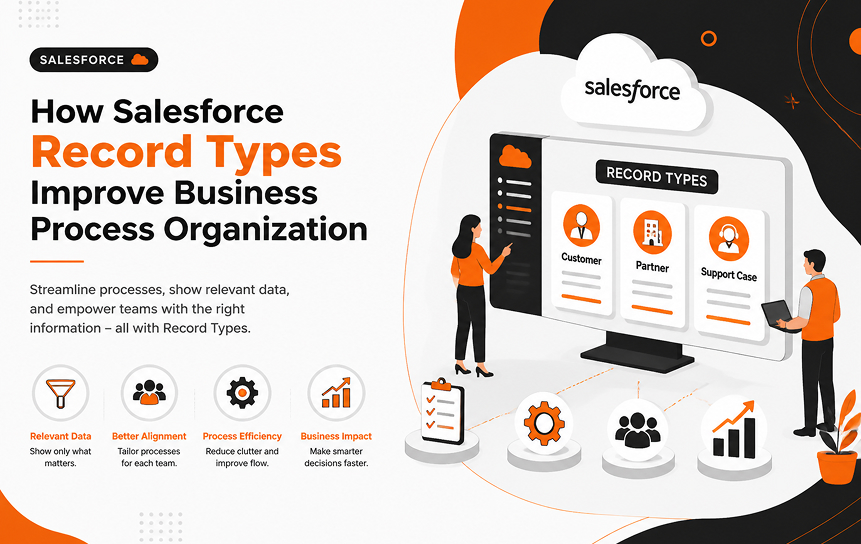
Salesforce record types play a central role in shaping how organizations structure and manage work inside Salesforce. At a practical level, they allow companies to separate business processes without creating fragmentation in their CRM architecture. This is where their real value becomes visible: instead of forcing every team into one rigid workflow, Salesforce record types enable structured flexibility.
When organizations implement Salesforce business processes across multiple departments, they quickly run into one common challenge—different teams need different ways of working, but they still need a unified system for reporting and visibility. Salesforce record types solve this by enabling Salesforce process segmentation inside a single object. That means sales, service, and operations teams can all use the same Salesforce object records, but follow different workflows, layouts, and data rules.
From a CRM architecture standpoint, this directly improves Salesforce data organization. Instead of duplicating objects or building workarounds, administrators can classify records based on business logic. This improves CRM record categorization and ensures that data remains structured at the point of entry.
Another major benefit is operational clarity. When users only see relevant fields and workflows, they are less likely to make mistakes. This reduces process confusion and strengthens Salesforce record management across the organization. It also improves adoption because users feel the system is tailored to their role rather than overloaded with irrelevant information.
In enterprise environments, Salesforce record types also support business process management by ensuring each workflow is standardized but still adaptable. This balance between structure and flexibility is what allows organizations to scale effectively without losing control over the CRM organization.
Supporting Multiple Departments
One of the strongest use cases for Salesforce record types is supporting multiple departments within the same system. In most organizations, sales, service, and operations teams operate under completely different Salesforce business processes, even though they are using the same platform.
For example, a sales team might focus on deal progression, while a service team focuses on case resolution, and an operations team manages internal requests. Without record types, these differences would require separate objects or overly complex configurations. With Salesforce record types, each department can operate independently while still contributing to a unified CRM structure.
This improves CRM organization by reducing fragmentation. Instead of building separate systems for each department, organizations can maintain one scalable architecture. This also improves Salesforce data organization because all related data remains within a consistent structure.
From a user experience perspective, this separation helps create better user experiences. Users only see fields and workflows relevant to their responsibilities, which reduces cognitive load and improves productivity.
Managing Different Sales Processes
Sales organizations rarely operate with a single workflow. In most real-world environments, there are multiple parallel sales motions. For example, new business acquisition, renewals, and upsells often require completely different approaches.
Salesforce record types allow these workflows to coexist within the same Opportunity object. Each record type can have its own stages, page layouts, and validation rules, ensuring that each Salesforce business process is properly structured.
This improves Salesforce process segmentation by ensuring that each deal type follows its own lifecycle. It also improves operational efficiency because sales reps are not forced to navigate irrelevant fields or stages.
From a reporting perspective, this structure improves visibility. Leaders can analyze performance by record type, which provides clearer insights into pipeline health and revenue distribution. This is especially important in enterprise sales environments where accuracy in Salesforce data organization directly impacts forecasting.
Handling Service Operations
Service operations benefit significantly from Salesforce record types because support environments are often complex and high-volume. Without structure, case management becomes inconsistent and difficult to scale.
By using Salesforce record types, organizations can separate cases into categories such as technical support, billing issues, account changes, or product inquiries. Each category can have its own workflow, page layout, and picklist values.
This improves Salesforce record management by ensuring that agents only see relevant information for the type of case they are handling. It also reduces resolution time because agents are not distracted by unnecessary fields or processes.
In real-world implementations, this structure directly improves operational efficiency. Service teams can route cases more effectively, prioritize work based on case type, and maintain consistent service quality.
It also strengthens CRM record categorization, which is critical for reporting and customer experience analysis.
Improving Operational Visibility
One of the often overlooked benefits of Salesforce record types is improved operational visibility. When records are properly categorized at the point of entry, reporting becomes significantly more accurate.
Instead of manually filtering data or relying on complex report logic, managers can analyze performance directly based on record type. This improves Salesforce data organization and ensures that insights reflect real business activity.
For example, a company can easily compare performance between new business sales and renewal sales without additional customization. This level of clarity is essential for business process management and strategic decision-making.
It also improves alignment between teams because everyone works within clearly defined structures.
Aligning CRM Structure With Business Needs
As organizations evolve, their Salesforce business processes also change. New products are launched, new departments are created, and workflows are continuously refined. Salesforce record types provide the flexibility needed to support this evolution without restructuring the entire CRM.
Instead of rebuilding objects, administrators can adjust record types to reflect new workflows. This helps maintain long-term CRM organization and reduces technical debt.
It also ensures that Salesforce object records remain consistent even as the business grows. This is critical for scalability and long-term system stability.
In platforms like Salesforce Lightning, this adaptability is further enhanced by modern interface tools that allow dynamic adjustments to user experiences.
Common Salesforce Record Type Use Cases
Salesforce record types are widely used across industries because they provide a structured way to manage CRM complexity.
In sales environments, they are commonly used to separate new business opportunities, renewal pipelines, and partner deals. This ensures each Salesforce business process follows a clearly defined structure.
In service environments, record types are used to categorize cases into technical, billing, and general support workflows. This improves Salesforce record management and helps service teams operate more efficiently.
In operations, record types are used for vendor management, internal requests, and procurement workflows. This ensures proper CRM record categorization and reduces administrative confusion.
Across all industries, the underlying goal remains the same: improve Salesforce data organization while maintaining flexibility.
Benefits of Using Record Types Effectively
When Salesforce record types are implemented correctly, the impact on business operations is significant. One of the most immediate benefits is improved user experience. Users only see relevant information, which creates cleaner interfaces and reduces confusion.
Another major benefit is better Salesforce data organization. Because data is categorized at entry, reporting becomes more reliable and meaningful.
Productivity also increases because users spend less time navigating unnecessary fields and more time completing tasks. This directly improves operational efficiency across departments.
In addition, Salesforce record types strengthen CRM record categorization, which ensures consistency across teams. This leads to better decision-making and more accurate forecasting.
Overall, they streamline Salesforce record management and help organizations scale without losing control over their CRM structure.
Common Mistakes Organizations Make With Record Types
Even though Salesforce record types are one of the most powerful tools in Salesforce for structuring CRM environments, they are also one of the most frequently misconfigured features in real-world implementations. In practice, many organizations introduce complexity instead of clarity because they do not design Salesforce record types around real Salesforce business processes.
One of the most common mistakes is creating too many record types. When organizations overuse Salesforce record types, they unintentionally weaken CRM organization. Instead of improving Salesforce data organization, they create fragmentation where users struggle to understand which record type to select. This leads to inconsistent Salesforce record management and reduced operational efficiency.
Another frequent issue is poor naming conventions. When record types are labeled inconsistently, users cannot easily interpret CRM record categorization. This increases process confusion and reduces adoption because the system no longer feels intuitive.
Misaligned page layouts are also a major problem. If Salesforce record types are not properly mapped to page layouts, users may see irrelevant fields or miss critical information. This directly harms user experience and reduces workflow alignment across teams.
A lack of governance is another serious challenge. Without structured oversight, Salesforce process segmentation becomes inconsistent over time. Different administrators may create overlapping or redundant record types, which weakens business process management and creates long-term maintenance challenges.
Finally, many organizations fail to plan for scalability. They design Salesforce record types for current needs but do not consider future growth. As a result, the system becomes difficult to maintain as new Salesforce business processes are introduced.
Best Practices for Salesforce Record Type Strategy
A strong Salesforce record type strategy starts with one principle: design around real business processes, not system convenience. When Salesforce record types reflect actual Salesforce business processes, they naturally improve CRM organization and reduce unnecessary complexity.
Organizations should begin by identifying how work is actually performed across departments. Sales, service, and operations teams all follow different workflows, and Salesforce record types should reflect that structure. This ensures proper Salesforce process segmentation and improves Salesforce data organization.
Keeping structures simple is another essential practice. A common mistake is assuming that more record types equal better control. In reality, excessive complexity reduces usability. A clean structure improves CRM record categorization and strengthens Salesforce record management over time.
Standardized naming conventions are also critical. Names should clearly reflect business intent so users immediately understand the purpose of each record type. This improves CRM organization and reduces training overhead.
Documentation is often overlooked but extremely important. Every Salesforce record type should have clear documentation explaining its purpose, related workflows, and assigned page layouts. This ensures consistency across teams and supports long-term governance.
Regular reviews are also necessary. As organizations evolve, Salesforce business processes change. Periodic audits ensure that record types remain aligned with operational reality and continue to support workflow alignment effectively.
In modern environments using Salesforce Lightning, these practices become even more important because dynamic interfaces increase flexibility, which also increases configuration responsibility.
Future Trends in Salesforce Process Organization
The future of CRM systems is moving toward more intelligent and adaptive design. Traditional static configurations like Salesforce record types will continue to play a role, but their usage will evolve as automation and AI become more deeply integrated into CRM platforms.
One major trend is AI-driven personalization. Systems are increasingly able to adapt interfaces and workflows based on user behavior. In this context, Salesforce record types will still support structure, but they may be supplemented by dynamic logic that reduces manual configuration.
Another emerging trend is intelligent process routing. Instead of relying only on static Salesforce process segmentation, future systems will automatically route records based on predictive models. This will enhance operational efficiency and reduce manual decision-making.
Dynamic user experiences are also becoming more common. With tools like Lightning App Builder, administrators can create interfaces that adjust based on context, reducing reliance on rigid structures.
Adaptive CRM architectures will further enhance Salesforce data organization by allowing systems to evolve continuously rather than through large redesign projects. This will significantly improve CRM organization and reduce long-term maintenance overhead.
Even as these advancements continue, Salesforce record types will remain foundational because they provide the structural base for CRM record categorization and workflow consistency.
Record Types vs Page Layouts
| Aspect | Salesforce Record Types | Page Layouts |
| Purpose | Separate business processes | Control user interface structure |
| Focus | Workflow segmentation | Field visibility and arrangement |
| Function | CRM record categorization | Screen design optimization |
| Impact | Process standardization | Improved user experience |
| Role in CRM | Structural layer | Presentation layer |
Benefits vs Challenges
| Benefits of Salesforce record types | Challenges if poorly implemented |
| Improve CRM structure | Over-segmentation complexity |
| Improve Salesforce data organization | Confusing configuration management |
| Increase operational efficiency | Higher maintenance overhead |
| Support workflow alignment | Risk of inconsistent usage |
| Enhance user experience | User confusion without governance |
Use Case Mapping by Department
| Department | Salesforce record types usage | Business outcome |
| Sales | New business, renewals, upsells | Structured pipeline management |
| Service | Technical, billing, general cases | Faster resolution times |
| Operations | Vendor and internal requests | Improved process control |
| Finance | Invoice and payment workflows | Accurate financial tracking |
Conclusion
Salesforce record types are a foundational element of CRM architecture that enable organizations to separate business processes, improve Salesforce data organization, and maintain scalable system design. When implemented correctly, they create structured workflows, reduce operational confusion, and improve CRM record categorization across departments.
By aligning Salesforce record types with real-world Salesforce business processes, organizations can improve efficiency, strengthen governance, and build a CRM system that evolves with business needs rather than restricting them.
Contact us to optimize your Salesforce record types and align your CRM with smarter business processes for better efficiency and usability.
FAQs
-
What are Salesforce record types used for?
Salesforce record types are used to separate and structure different Salesforce business processes within the same object. They improve CRM organization, support CRM record categorization, and ensure users only interact with relevant workflows and fields. This improves Salesforce data organization and reduces process confusion across departments.
-
How do record types differ from page layouts?
Salesforce record types define which business process a record belongs to, while page layouts define how that record is displayed on the screen. Record types control workflow segmentation, and page layouts control user interface design. Together, they improve CRM structure and user experience.
-
When should businesses use record types?
Businesses should use Salesforce record types when multiple Salesforce business processes exist within the same object. If different teams require different workflows, picklist values, or page layouts, record types help maintain structured Salesforce record management and improve operational efficiency.
-
Can record types improve reporting?
Yes, Salesforce record types improve reporting by ensuring data is consistently categorized at the point of entry. This strengthens Salesforce data organization, improves CRM record categorization, and enables more accurate business insights and forecasting.
-
How many record types should an organization create?
There is no fixed number, but organizations should only create Salesforce record types when necessary to support distinct business processes. Too many record types reduce usability, while too few limit flexibility and workflow alignment.
-
What are common record type management mistakes?
Common mistakes include creating too many record types, inconsistent naming conventions, misaligned page layouts, lack of governance, and poor scalability planning. These issues weaken CRM organization and negatively impact Salesforce record management.


