
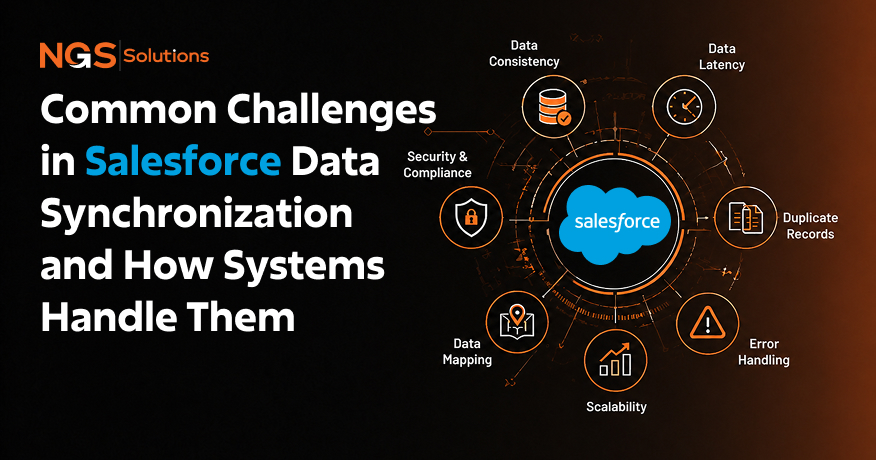
As organizations expand their digital ecosystems, maintaining accurate and connected information becomes increasingly difficult. Businesses rely on multiple applications to manage sales, finance, customer service, inventory, and operations. While these systems provide valuable functionality, they also create a new challenge: keeping data aligned across platforms.
This is where Salesforce data synchronization challenges become a major concern. Salesforce often serves as the central CRM platform, but it frequently exchanges information with ERP systems, marketing tools, customer portals, cloud applications, and data warehouses. When data moves between multiple platforms, even a small issue can trigger reporting inaccuracies, workflow disruptions, and customer service problems.
Many companies encounter Salesforce data sync issues, CRM data synchronization problems, and various system synchronization errors as their integration environments grow. Whether the organization uses Salesforce with SAP, Oracle ERP, MuleSoft, or a Master Data Management platform, synchronization reliability directly impacts business performance.
Understanding the common Salesforce data synchronization problems that affect enterprise environments can help organizations improve operational efficiency, strengthen data governance, and maintain long-term data quality. This article explores the most frequent synchronization obstacles and explains how modern systems address them.
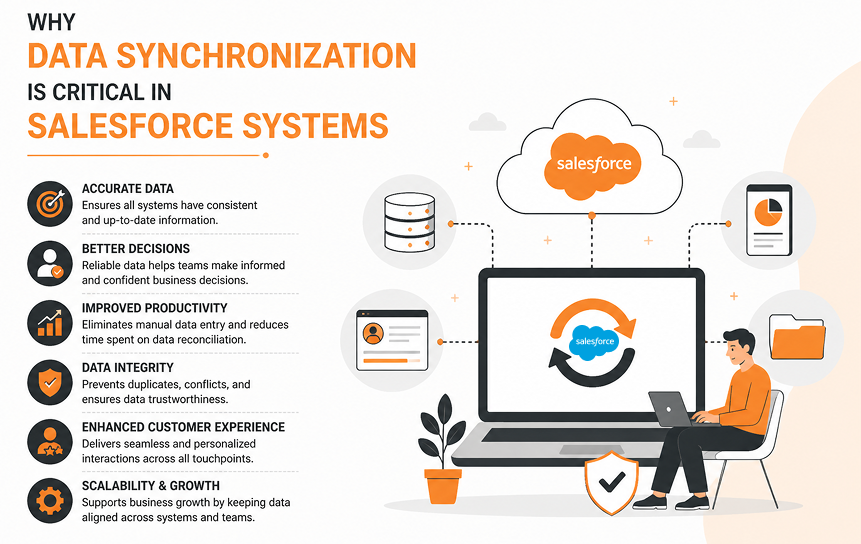
Why Data Synchronization Is Critical in Salesforce Systems
Importance of Real-Time Data Accuracy
Modern organizations depend on accurate information to support daily operations. Sales teams need current customer details, finance departments require updated transaction records, and service agents rely on complete account histories.
When systems fail to share information correctly, employees may work with outdated records. This can result in missed opportunities, inaccurate communications, and operational inefficiencies.
Maintaining data consistency in Salesforce helps organizations improve data accuracy and make better business decisions. Reliable synchronization processes also help maintain real-time updates that support fast-moving business environments.
For example, when a customer changes their contact information through an online portal, Salesforce should receive the update immediately. Delays can create confusion and reduce service quality.
Role of Integrated Systems
Today’s businesses rarely rely on a single application. Salesforce frequently integrates with ERP platforms, accounting systems, e-commerce applications, customer support tools, and analytics platforms.
A company may use Salesforce for customer relationship management while using SAP for supply chain operations and Oracle ERP for financial management. Each platform contains information that must remain aligned.
Without effective enterprise data synchronization, organizations risk data discrepancies between systems. Successful integration strategies help keep data consistent across systems while reducing manual data entry and operational inefficiencies.
Impact on Business Operations
Synchronization failures can affect nearly every business function.
A delayed order update may impact inventory planning. An inaccurate customer profile may disrupt sales activities. A financial discrepancy may create compliance concerns.
Organizations experiencing frequent Salesforce data sync issues often discover that small synchronization failures can produce significant downstream effects. As business systems become increasingly interconnected, synchronization reliability becomes essential for operational continuity.
Customer Experience Implications
Customers expect organizations to provide seamless experiences across every interaction channel.
If a customer updates information through a website but the update never reaches Salesforce, service representatives may continue using outdated records. This inconsistency creates frustration and damages trust.
Reliable synchronization helps organizations avoid duplicate customer records, improve communication accuracy, and deliver personalized experiences.
Customers rarely see synchronization technology directly, but they quickly notice its failures.
Decision-Making Dependence on Data
Business leaders rely on reports, dashboards, and analytics to guide strategic decisions.
Poor synchronization can lead to incomplete reports, conflicting metrics, and inaccurate forecasts. Decision-makers need confidence that the information they review reflects current business conditions.
Strong synchronization practices help organizations ensure data integrity, improve reporting accuracy, and support informed decision-making.
Challenge #1: Data Conflicts Between Systems
Why Conflicts Occur
Among the most common Salesforce data synchronization challenges are data conflicts. These occur when multiple systems attempt to update the same record with different values.
For example, Salesforce may contain one customer address while an ERP system stores another version. During synchronization, the integration platform must determine which value should be retained.
These situations become increasingly common in complex enterprise environments where multiple applications manage customer, product, or financial information.
Simultaneous Data Updates
Simultaneous updates are a leading cause of synchronization conflicts.
Imagine a sales representative updates a customer’s phone number in Salesforce while a finance employee modifies the same record in Oracle ERP. Both changes may occur within seconds of one another.
Without proper synchronization controls, systems may overwrite valid updates or create conflicting records. These real-time sync issues can affect data quality and user trust.
Organizations seeking to understand why Salesforce data sync fails between systems often discover that concurrent updates are a major contributor.
Version Control Issues
A version mismatch occurs when systems process outdated information after newer data has already been recorded elsewhere.
For example, one system may synchronize a record from five minutes ago while another system already contains a more recent update. If version tracking is not properly implemented, older information may overwrite newer data.
Version mismatch problems are particularly common in distributed enterprise environments with multiple integration points.
Organizations must establish clear synchronization priorities to reduce these risks.
Conflict Resolution Methods
Modern integration platforms use several approaches to resolve synchronization conflicts.
Common methods include:
- Timestamp comparison
- Source-system prioritization
- Master record designation
- Business rule enforcement
- Manual review workflows
Many organizations rely on Master Data Management solutions to define a trusted source of truth. These platforms manage master data and support consistent synchronization decisions across enterprise systems.
Effective data reconciliation processes also help identify and correct discrepancies before they affect business operations.
Preventing Future Conflicts
The most effective strategy is preventing conflicts before they occur.
Organizations focused on preventing data conflicts in Salesforce integrations often implement:
- Data ownership policies
- Source-of-truth definitions
- Validation rules
- Timestamp tracking
- Governance frameworks
Clearly defined business rules help ensure every system understands which application owns specific information.
These controls significantly reduce synchronization failures while improving overall data quality.
Challenge #2: Duplicate Records Across Systems
Causes of Duplicate Data Creation
Duplicate records remain one of the most frustrating synchronization problems organizations face.
Duplicates often emerge when multiple systems create customer records independently without verifying whether an existing record already exists.
Common causes include:
- Manual entry mistakes
- Import processes
- API failures
- Incomplete matching logic
- Integration design flaws
These issues frequently contribute to broader CRM data synchronization problems.
Impact on Reporting and Analytics
Duplicate records can severely distort business reporting.
When multiple versions of the same customer exist, sales forecasts become less reliable. Marketing teams may overestimate audience size, while service teams struggle to maintain complete customer histories.
Organizations attempting to improve data accuracy often discover that duplicate data is a primary source of reporting inconsistencies.
Duplicate records can also increase operational costs and reduce user confidence in business systems.
Data Deduplication Strategies
Organizations use several methods to reduce data duplication.
Popular approaches include:
- Automated matching algorithms
- Record-merging tools
- Identity resolution systems
- Duplicate detection workflows
- Data quality monitoring
Many companies integrate Salesforce with Master Data Management solutions to improve matching accuracy and maintain cleaner records.
These tools help identify duplicate records before they spread throughout the organization.
System-Level Prevention Techniques
Modern integration platforms include preventative controls designed to stop duplicates before they occur.
Examples include:
- Unique identifier validation
- Email matching rules
- Customer ID verification
- Real-time duplicate alerts
- Cross-system record matching
These controls help organizations avoid duplicate customer records while improving overall synchronization performance.
Prevention is typically less expensive than correcting duplicate data after it has spread across multiple systems.
Data Cleansing Methods
Even organizations with strong controls require ongoing data maintenance.
Regular cleansing activities include:
- Duplicate audits
- Data quality reviews
- Historical record cleanup
- Data standardization initiatives
- Automated reconciliation processes
These efforts help improve data consistency in Salesforce while supporting long-term data integrity.
Companies that invest in routine cleansing activities typically experience fewer synchronization issues and more reliable reporting outcomes.
Challenge #3: Real-Time Synchronization Failures
API Latency Issues
Real-time integrations depend heavily on APIs to transfer information between systems. When APIs respond slowly, synchronization processes can experience delays that affect business operations.
One of the most common causes of real-time sync issues is synchronization latency. Latency occurs when information takes longer than expected to move from one application to another. Even a delay of a few minutes can create problems when sales teams, service agents, or finance departments rely on immediate access to updated records.
For example, a customer may place an order through an online portal that integrates with Salesforce. If API latency delays the update, sales representatives may not see the transaction right away. This can create confusion and affect customer interactions.
Organizations can improve performance by optimizing API calls, reducing unnecessary data transfers, and monitoring integration traffic continuously.
Network Interruptions
Network reliability plays a critical role in synchronization success.
When internet connections become unstable or communication channels are interrupted, synchronization processes may fail before completing data transfers. These interruptions can result in missing updates, incomplete transactions, and temporary data inconsistencies.
Businesses operating globally often face additional challenges because data travels across multiple geographic regions and cloud environments.
To improve system reliability, organizations typically implement redundant network paths, automated recovery mechanisms, and transaction logging capabilities.
System Downtime Problems
System availability directly affects synchronization performance.
Even well-designed integrations can experience failures when one of the connected applications becomes unavailable. Scheduled maintenance, software upgrades, cloud outages, or infrastructure failures can all interrupt synchronization activities.
Consider a scenario where Salesforce remains online while an integrated Oracle ERP environment undergoes maintenance. Updates generated during the outage may accumulate in queues and require processing later.
Without proper recovery procedures, organizations may encounter system synchronization errors that impact reporting, operations, and customer service.
Retry Mechanisms
Modern integration platforms use automated retry capabilities to reduce synchronization failures.
Rather than abandoning a failed transaction immediately, the system attempts to resend information after a specified delay. Advanced retry frameworks often use escalating intervals to prevent excessive system load.
Common retry techniques include:
- Automated retries
- Exponential backoff logic
- Transaction queuing
- Dead-letter processing
- Error classification workflows
These approaches help organizations fix integration errors automatically while minimizing manual intervention.
When properly configured, retry mechanisms significantly improve synchronization reliability.
Monitoring Sync Health
Monitoring is essential for maintaining healthy integrations.
Organizations that proactively track synchronization performance can identify issues before they become major business problems.
Important metrics include:
- API response times
- Synchronization success rates
- Error frequency
- Queue processing volumes
- System availability
Continuous monitoring helps teams identify event timing issues, detect unusual synchronization behavior, and maintain operational visibility.
Companies that invest in monitoring often experience fewer outages and stronger integration performance.
Challenge #4: Batch Processing Delays
Scheduled Sync Limitations
Not every organization requires immediate synchronization. Many businesses rely on scheduled batch jobs to transfer information between systems.
While batch processing can reduce infrastructure costs, it also introduces delays. Information remains unchanged until the next synchronization cycle runs.
These batch sync challenges can create temporary inconsistencies between applications. Employees may unknowingly make decisions based on outdated information.
Understanding real-time vs batch sync problems in Salesforce is essential when designing integration architectures.
Data Backlogs
As transaction volumes increase, synchronization queues can become overloaded.
A backlog develops when systems generate data faster than synchronization processes can handle it. During busy periods, thousands of records may wait for processing.
Large enterprises frequently encounter this issue when synchronizing Salesforce with SAP, Oracle ERP, and other high-volume business systems.
Backlogs increase synchronization latency and can affect overall business performance.
Processing Bottlenecks
Processing bottlenecks occur when integration resources become constrained.
Common causes include:
- Limited computing capacity
- Database performance issues
- Complex transformation logic
- API limitations
- Excessive validation requirements
For example, an integration workflow that performs dozens of validation checks on every record may require significantly more processing time than a streamlined workflow.
Organizations must regularly review synchronization architecture to identify bottlenecks before they impact operations.
Optimization Techniques
Several strategies can improve batch synchronization performance.
Organizations often implement:
- Incremental synchronization
- Parallel processing
- Database optimization
- Data compression
- Selective record updates
Incremental synchronization is particularly effective because it transfers only modified records rather than entire datasets.
These optimization techniques help organizations improve performance while reducing resource consumption.
Hybrid Sync Models
Many enterprises combine real-time and batch synchronization approaches.
Critical customer information may synchronize immediately, while historical records and analytical data move through scheduled batch processes.
This hybrid approach allows organizations to balance performance, scalability, and cost.
Businesses evaluating real-time vs batch sync problems in Salesforce often discover that hybrid models provide the greatest flexibility.
How Systems Handle Synchronization Challenges
Middleware-Based Solutions
Middleware serves as the foundation of many enterprise integration environments.
Instead of creating direct connections between every application, organizations use platforms such as MuleSoft to centralize communication and data exchange.
Middleware platforms provide several advantages:
- Centralized integration management
- Improved scalability
- Enhanced monitoring
- Simplified maintenance
- Standardized connectivity
By using middleware, organizations can streamline data exchange between Salesforce, SAP, Oracle ERP, and other systems while reducing integration complexity.
Middleware solutions are particularly valuable in large enterprise environments where dozens of applications must communicate consistently.
Event-Driven Architecture Solutions
Event-driven architectures are becoming increasingly popular because they support near-real-time synchronization.
In this model, systems generate events whenever important changes occur. These events trigger synchronization actions automatically.
For example, when a customer record changes in Salesforce, an event can immediately notify connected systems. The update is then processed without waiting for a scheduled synchronization cycle.
This approach helps organizations:
- Maintain real-time updates
- Reduce synchronization latency
- Improve responsiveness
- Increase scalability
- Support modern digital experiences
Event-driven architectures are especially effective for organizations that require immediate visibility across multiple systems.
API Retry and Error Handling
Successful integrations require more than connectivity. They also require resilience.
Modern platforms include sophisticated error-handling frameworks that detect failures, classify exceptions, and initiate recovery procedures automatically.
Examples include:
- Retry workflows
- Error queues
- Transaction replay mechanisms
- Exception notifications
- Recovery automation
These capabilities help organizations reduce downtime and maintain operational continuity even when unexpected failures occur.
Strong error-handling strategies also help improve system reliability across complex integration environments.
Data Validation Layers
Validation plays an important role in synchronization quality.
Before information moves between systems, validation layers verify that records meet predefined requirements.
Validation checks commonly include:
- Required field verification
- Data format validation
- Business rule enforcement
- Reference integrity checks
- Duplicate detection
By validating information before synchronization occurs, organizations can prevent bad data from spreading across multiple systems.
These controls help improve data accuracy and reduce costly correction efforts later.
Centralized Data Governance
Technology alone cannot solve synchronization problems. Organizations also need strong governance.
Centralized governance establishes clear standards for how information is created, managed, and synchronized throughout the enterprise.
Key governance activities include:
- Data ownership assignment
- Quality standards definition
- Master data management
- Compliance oversight
- Change management
Many organizations use Master Data Management programs to establish a trusted source of truth.
Strong governance helps maintain data integrity, improve consistency, and reduce synchronization-related risks.
Best Practices to Improve Salesforce Data Synchronization
Standardize Data Formats
One of the simplest ways to reduce synchronization problems is to standardize data structures across systems.
Inconsistent formatting often creates unnecessary synchronization failures.
Examples include:
- Different date formats
- Address inconsistencies
- Varying phone number structures
- Currency formatting differences
Standardization helps systems communicate more effectively and reduces processing complexity.
Organizations focused on improving Salesforce data consistency across systems often begin with data standardization initiatives.
Implement Strong Validation Rules
Validation rules prevent poor-quality information from entering business systems.
Salesforce provides powerful validation capabilities that help enforce organizational standards.
Effective validation may include:
- Required field checks
- Format restrictions
- Range validations
- Duplicate prevention controls
- Workflow enforcement
These measures help organizations improve data accuracy while reducing synchronization failures.
Monitor Sync Performance
Continuous monitoring remains one of the most effective synchronization management practices.
Organizations should regularly evaluate:
- Success rates
- Processing times
- Error trends
- Queue volumes
- API performance
Monitoring allows teams to identify potential issues before they become major operational disruptions.
This proactive approach supports long-term synchronization reliability and operational stability.
Use Middleware for Complex Systems
As integration environments grow, direct system-to-system connections become increasingly difficult to manage.
Middleware platforms such as MuleSoft provide centralized control, improved visibility, and enhanced scalability.
Organizations integrating Salesforce with SAP and Oracle ERP often use middleware to simplify architecture and reduce maintenance requirements.
Middleware also helps businesses keep data consistent across systems while supporting enterprise-scale synchronization demands.
Establish Data Ownership
Clear ownership is critical for reducing synchronization conflicts.
Every important data element should have a designated source system responsible for maintaining accuracy.
For example:
- Salesforce may own customer relationship data.
- SAP may own inventory information.
- Oracle ERP may own financial records.
- Master Data Management platforms may govern shared customer and product information.
Defined ownership structures help organizations resolve synchronization conflicts, reduce ambiguity, and strengthen governance practices.
Future of Data Synchronization Systems
As enterprise technology continues to evolve, organizations are demanding faster, smarter, and more reliable synchronization capabilities. Traditional integration methods are gradually being enhanced by intelligent automation, machine learning, and event-driven architectures that can respond to changing business conditions in real time.
Future synchronization platforms will not only move data between systems but also identify potential issues before they affect operations. These innovations will help organizations reduce costs, improve efficiency, and maintain higher levels of data quality across increasingly complex technology environments.
AI-Based Conflict Resolution
One of the most promising developments in synchronization technology is artificial intelligence-driven conflict resolution.
Traditionally, organizations rely on predefined rules to determine which system should win when conflicting updates occur. While effective in many situations, static rules may not always account for changing business requirements.
AI-powered systems can analyze historical synchronization behavior, user activity patterns, and contextual information to make smarter decisions. Instead of simply applying a timestamp rule, the system can evaluate the source, business impact, and likelihood of accuracy before determining the correct outcome.
These capabilities help organizations reduce manual intervention and more effectively resolve synchronization conflicts.
As AI continues to mature, businesses can expect more intelligent handling of data conflicts, version mismatch situations, and complex synchronization scenarios.
Real-Time Streaming Systems
Real-time streaming technologies are becoming increasingly important as organizations seek immediate access to operational information.
Unlike traditional batch processing, streaming architectures continuously transmit updates as events occur. This approach significantly reduces synchronization latency and improves responsiveness across integrated environments.
For example, when a customer places an order, updates their profile, or submits a support request, connected systems can receive the information almost instantly.
Organizations implementing real-time streaming often experience:
- Faster decision-making
- Improved customer experiences
- Better operational visibility
- Reduced delays
- Enhanced scalability
These capabilities support modern digital business models that depend on rapid access to accurate information.
Autonomous Data Sync
The future of integration is moving toward autonomous synchronization.
Autonomous systems use intelligent monitoring, automation, and predictive analytics to manage synchronization processes with minimal human involvement.
Future platforms may automatically:
- Detect synchronization failures
- Fix integration errors
- Optimize performance settings
- Adjust synchronization schedules
- Repair data inconsistencies
These capabilities help organizations improve system reliability while reducing administrative workload.
Autonomous synchronization also supports larger integration environments where manual oversight becomes increasingly difficult.
Predictive Data Correction
Predictive analytics is transforming the way organizations manage data quality.
Instead of reacting to errors after they occur, future synchronization platforms will identify potential issues before they affect business operations.
Predictive models may detect:
- Emerging duplicate records
- Potential synchronization failures
- High-risk integration points
- Data quality degradation
- Abnormal transaction patterns
These capabilities allow organizations to proactively address issues and maintain higher levels of accuracy.
As predictive technologies improve, businesses will be better equipped to ensure data integrity while reducing operational risks.
Conclusion
As organizations continue expanding their digital ecosystems, managing information across multiple platforms becomes increasingly complex. Salesforce rarely operates as a standalone application, which means businesses must establish reliable synchronization processes to support sales, customer service, finance, and operational workflows.
The most significant Salesforce data synchronization challenges include data conflicts, duplicate records, synchronization latency, system errors, event timing issues, and batch processing limitations. These issues can negatively affect customer experiences, reporting accuracy, operational efficiency, and overall business performance if left unresolved.
Understanding the common Salesforce data synchronization problems that occur in enterprise environments is the first step toward building more reliable integrations. Organizations that understand why Salesforce data sync fails between systems can proactively address weaknesses before they impact business operations.
Successful integration strategies focus on preventing data conflicts in Salesforce integrations, strengthening governance practices, and implementing technologies that support long-term reliability. Businesses seeking to fix Salesforce synchronization issues should prioritize monitoring, validation, automation, and clear ownership models.
Organizations that invest in middleware platforms such as MuleSoft, establish strong Master Data Management practices, and create effective governance frameworks are better positioned to achieve sustainable integration success. These approaches help keep data consistent across systems, improve data accuracy, maintain real-time updates, and ensure data integrity across the enterprise.
As artificial intelligence, predictive analytics, and autonomous synchronization technologies continue to mature, the future of enterprise data synchronization will become increasingly intelligent and resilient. Businesses focused on improving Salesforce data consistency across systems will gain a competitive advantage through better decision-making, stronger customer experiences, and more reliable business operations.
Ultimately, overcoming Salesforce data synchronization challenges requires a combination of technology, governance, and continuous improvement. Organizations that embrace these principles can reduce synchronization risks, improve system reliability, and build a stronger foundation for long-term growth.
FAQs
-
What causes Salesforce data synchronization issues?
Several factors can contribute to synchronization failures across enterprise systems. Common causes include API limitations, network disruptions, incompatible data formats, conflicting business rules, insufficient validation controls, and infrastructure outages.
Many organizations also experience synchronization problems when multiple applications attempt to update the same record simultaneously. This can create data conflicts, duplicate records, and version mismatch issues that affect reporting accuracy and operational efficiency.
Among the most common Salesforce data synchronization challenges are inconsistent ownership rules, poor governance practices, and inadequate monitoring. Businesses that proactively address these areas typically experience fewer synchronization failures and stronger data quality.
-
How do systems fix data conflicts?
Modern integration platforms use several methods to resolve conflicting information.
Common approaches include:
- Timestamp-based comparisons
- Source-system prioritization
- Master record assignment
- Automated data reconciliation
- Manual review processes
Organizations using Salesforce alongside SAP, Oracle ERP, and Master Data Management platforms often establish a single source of truth to simplify synchronization decisions.
Strong governance frameworks and clearly defined business rules help reduce conflicts while maintaining consistent information across applications.
-
Why do duplicate records occur in Salesforce?
Duplicate records typically occur when multiple systems create customer information independently without recognizing existing records.
Common causes include:
- Manual data entry
- Import processes
- Missing validation controls
- Inconsistent identifiers
- Synchronization failures
Duplicate records can negatively impact reporting, customer service, and marketing effectiveness.
To avoid duplicate customer records, organizations often implement matching algorithms, identity resolution tools, validation rules, and ongoing data quality initiatives. These efforts help reduce data duplication and improve overall information accuracy.
-
What is real-time data synchronization?
Real-time data synchronization refers to the immediate exchange of information between connected systems whenever a change occurs.
Instead of waiting for a scheduled synchronization cycle, updates are transmitted automatically and processed almost instantly.
This approach helps organizations:
- Maintain real-time updates
- Improve customer experiences
- Accelerate decision-making
- Increase operational visibility
- Reduce synchronization delays
Real-time synchronization is especially valuable for customer service, sales, inventory management, and financial operations where current information is critical.
-
How does middleware help synchronization?
Middleware acts as a central integration layer between business applications.
Rather than building direct connections between every system, organizations use middleware platforms such as MuleSoft to manage communication, transformation, validation, and monitoring activities.
Middleware provides several benefits:
- Simplified integration architecture
- Enhanced scalability
- Better monitoring capabilities
- Improved error handling
- Consistent data exchange
Organizations that use middleware can streamline data exchange, improve operational efficiency, and maintain more reliable synchronization processes across complex environments.
-
Can Salesforce handle real-time sync?
Yes. Salesforce supports real-time synchronization through APIs, platform events, webhooks, and change data capture technologies.
These capabilities allow Salesforce to exchange information with external applications immediately after changes occur.
Organizations frequently integrate Salesforce with SAP, Oracle ERP, customer portals, e-commerce platforms, and cloud applications to support real-time business processes.
When combined with proper architecture, governance, and monitoring, Salesforce can effectively support enterprise-grade synchronization requirements.


