
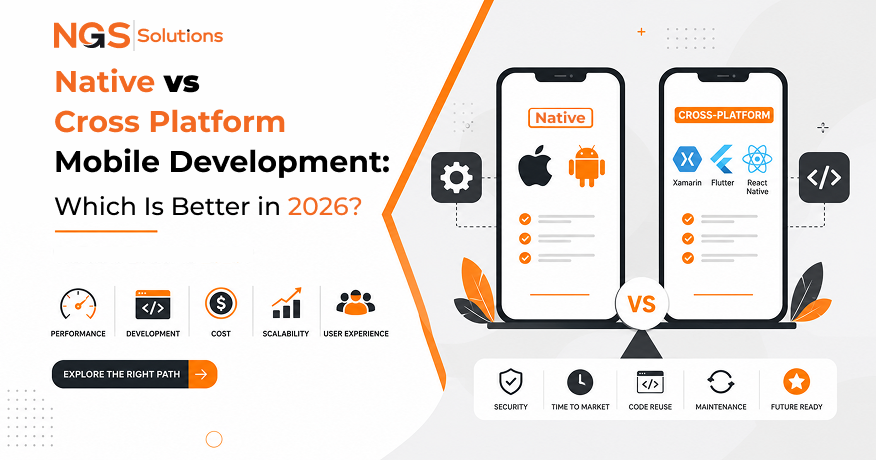
Every successful mobile app starts with the right foundation. The decision between native vs cross platform mobile development influences how your app performs, how much it costs to build and maintain, and how easily it can grow over time. Whether you’re creating a new product or expanding an existing one, understanding the differences between a native app vs cross platform solution can help you choose the approach that best supports your business goals.
As mobile usage continues to grow, businesses are investing more in digital experiences than ever before. The U.S. Census Bureau reported that retail e-commerce sales reached $326.7 billion in the first quarter of 2026, a 9.8% increase compared to the same period the previous year. This continued growth is driving organizations to invest in mobile applications that deliver reliable performance and a seamless user experience, making native vs cross platform for enterprise apps an increasingly important consideration.
This guide explains how native and cross platform development work, where each approach performs best, and the key factors to consider, including performance, cost, security, scalability, maintenance, and popular frameworks.
What Is Native Mobile Development?
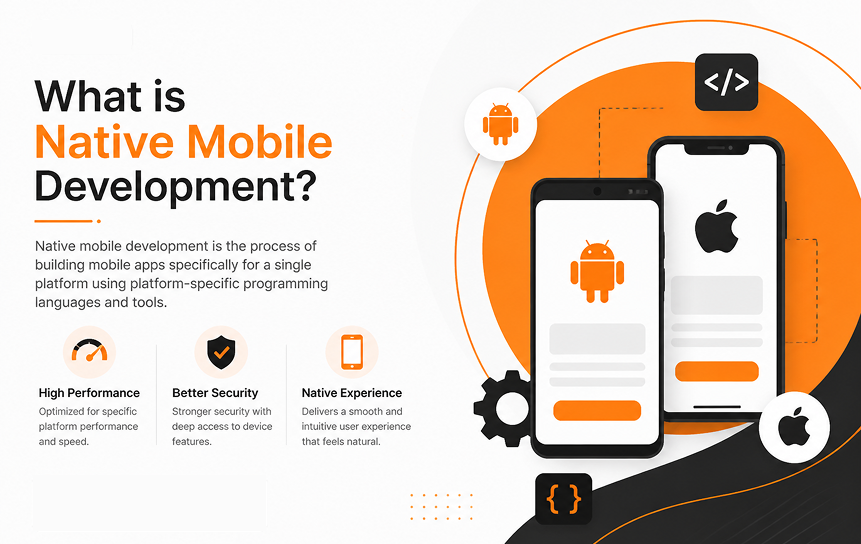
Native mobile app development is the process of creating native mobile apps specifically for a single operating system, such as iOS or Android. Businesses that want to develop a mobile app with high performance and platform-specific functionality often choose this approach. It uses platform-specific programming languages, tools, and software development kits (SDKs) supplied by Apple and Google. Since each app is designed for one platform, it can fully utilize the device’s hardware, operating system capabilities, and native features, delivering high performance, enhanced security, and a seamless user experience.
How Native Mobile Development Works
Native applications are built separately for each mobile operating system, making native app development a preferred approach for creating high-performance mobile experiences. In native application development, developers create apps specifically for platforms such as iOS and Android. For iOS, developers typically use Swift together with Apple’s Xcode development environment, while Android applications are commonly developed with Kotlin using Android Studio.
Each version of the application has its own codebase, allowing developers to optimize every feature for the target platform. When users install the app, it communicates directly with the operating system instead of relying on compatibility layers.
This direct interaction improves responsiveness, animation quality, and overall stability. Developers also gain immediate access to newly released platform features, APIs, and security updates without waiting for third-party framework support.
Although maintaining separate codebases requires additional effort, native app development provides greater flexibility when designing complex applications with demanding performance requirements.
Key Features of Native Development
Native development focuses on delivering applications that closely match the expectations of each operating system. Every interface component follows official design guidelines, making the application feel familiar to users.
Some notable features include:
- Platform-specific user interface components
- Direct access to device hardware
- Full support for operating system updates
- Optimized memory and battery usage
- Better graphics rendering
- Faster application startup
- Strong integration with platform security features
- Reliable access to APIs and SDKs
Because developers work directly with official development tools, they can build highly customized applications without many of the limitations found in shared code frameworks. This flexibility is especially valuable for businesses developing feature-rich applications that require consistent performance across millions of users.
Advantages of Native Mobile Development
Many organizations choose native development because it delivers the highest level of performance and reliability.
Key advantages include:
- Excellent speed and responsiveness
- Smooth animations and transitions
- Better battery efficiency
- Stronger security controls
- Complete access to device capabilities
- Faster adoption of new iOS and Android features
- Improved stability for complex applications
- Superior user experience
Native applications are especially effective for software that performs intensive processing, handles large datasets, streams high-quality media, or relies on real-time communication. Since developers can optimize every feature specifically for one operating system, they often achieve better results than shared-code alternatives.
These benefits make native development a preferred option for enterprise software, financial applications, healthcare platforms, and high-performance consumer apps.
Disadvantages of Native Mobile Development
Despite its strengths, native development also introduces challenges that organizations should evaluate before starting a project.
Common disadvantages include:
- Separate codebases for iOS and Android
- Higher development costs
- Longer development timelines
- Larger development teams
- Increased maintenance effort
- More testing across platforms
- Higher long-term operational expenses
Businesses planning to launch on both major mobile platforms must essentially build two applications instead of one. While many components, such as backend services, can be shared, the mobile interfaces require separate implementation.
For startups with limited budgets, these additional costs may influence the decision between native vs cross platform mobile development, particularly during the early stages of product development.
Best Use Cases for Native Apps
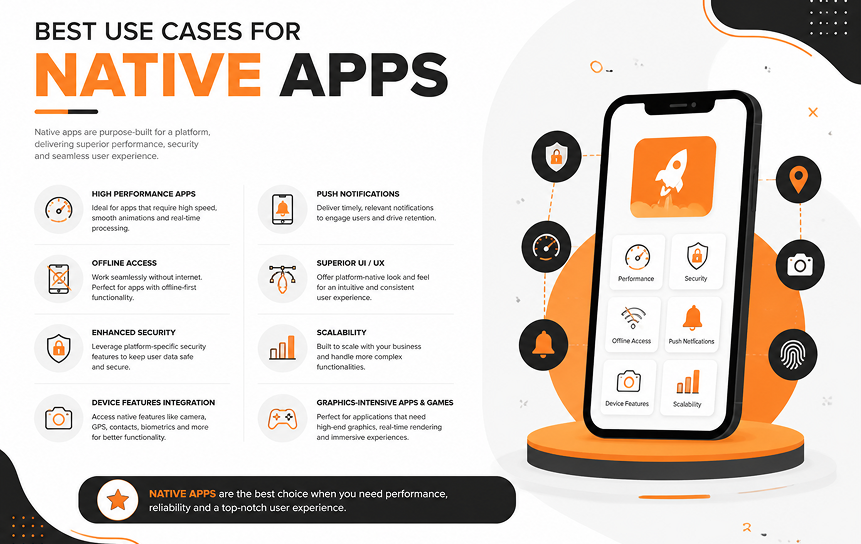
Native applications work best when performance, reliability, and user experience are the highest priorities.
Typical use cases include:
- Banking and financial applications
- Healthcare software
- Mobile gaming
- Augmented reality (AR) applications
- Virtual reality (VR) experiences
- Enterprise productivity tools
- Professional video editing apps
- Navigation applications
- High-security government software
- Streaming platforms
These applications often process significant amounts of data, rely on advanced hardware features, or require fast response times. Native development gives engineering teams greater control over optimization, making it easier to deliver consistent performance under demanding workloads.
What Is Cross Platform Mobile Development?
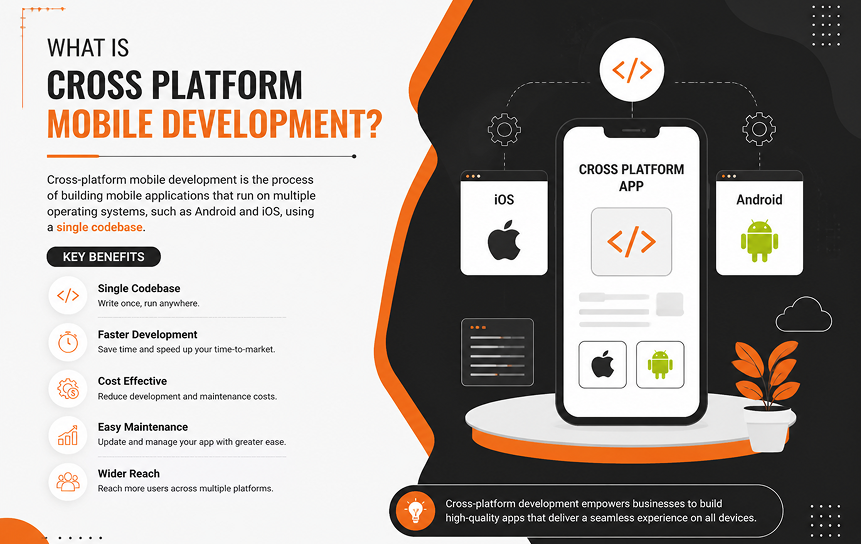
Cross platform application development enables developers to create a single application that runs across multiple operating systems using a shared codebase. Instead of building separate apps for Android and iOS, developers can use cross platform frameworks to create efficient cross platform apps with reusable code, reducing development time while maintaining consistent functionality and user experience across different platforms.
How Cross Platform Development Works
Cross platform frameworks introduce an additional software layer between the application and the operating system. Developers write most of the application once using a supported programming language, while the framework translates or bridges that code into platform-specific components. This is why many businesses choose cross platform development solutions to build applications efficiently for both Android and iOS.
Modern frameworks have improved significantly in recent years and now offer performance that meets the needs of many business applications.
Key characteristics include:
- Shared codebase across platforms
- Reduced duplicate development
- Faster release cycles
- Consistent business logic
- Simplified maintenance
- Support for multiple operating systems
- Access to many native APIs through plugins
Although certain advanced device capabilities may still require native modules, most everyday business applications can be developed efficiently using this approach.
Key Features of Cross Platform Development
Cross platform development emphasizes development efficiency while delivering similar experiences across multiple devices.
| Feature | Native Development | Cross Platform Development |
| Codebase | Separate for each platform | Mostly shared |
| Development Speed | Slower | Faster |
| Maintenance | Multiple codebases | Single primary codebase |
| Cost | Higher | Lower |
| Platform Support | One platform per project | Multiple platforms |
| UI Consistency | Platform-specific | Consistent across platforms |
Organizations often choose cross platform development because it balances development speed with acceptable performance for many commercial applications.
Advantages of Cross Platform Development
Cross platform development helps organizations launch products more efficiently.
Major advantages include:
- Lower development costs
- Faster deployment
- Shared code across platforms
- Easier maintenance
- Smaller development teams
- Consistent user experience
- Faster feature updates
For startups and businesses validating a new product idea, these benefits can significantly reduce both development time and initial investment.
Disadvantages of Cross Platform Development
Cross platform development also has trade-offs that should be considered.
Common limitations include:
- Slightly lower performance for demanding applications
- Limited access to some new platform features
- Dependency on framework updates
- Additional optimization for complex interfaces
- Possible compatibility issues with certain device APIs
Many of these challenges have become less significant as modern frameworks continue to mature, but they can still influence projects with specialized technical requirements.
Best Use Cases for Cross Platform Apps
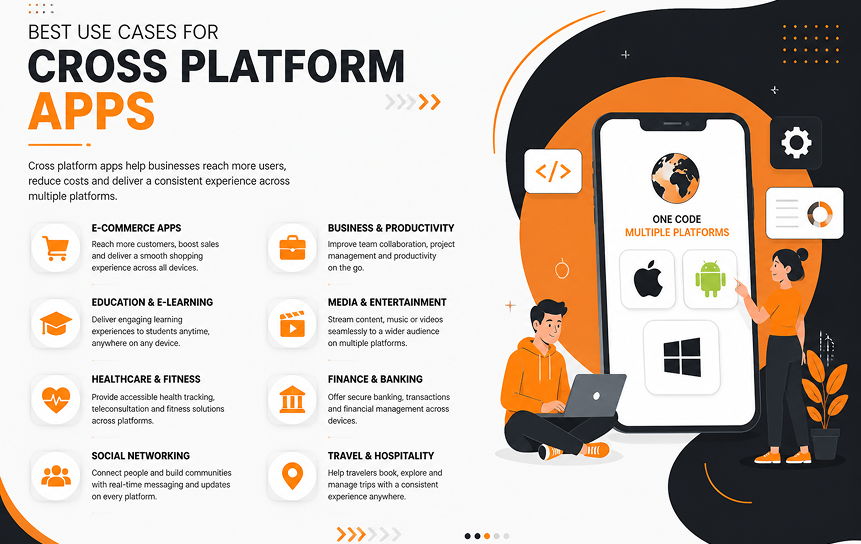
Cross platform development is an excellent choice for organizations that need to deliver applications quickly while controlling costs.
Ideal use cases include:
- Startup products
- Minimum viable products (MVPs)
- Internal business applications
- E-commerce apps
- Booking platforms
- Educational applications
- News applications
- Customer loyalty apps
- Business dashboards
- Content management tools
These projects typically prioritize rapid development, consistent functionality, and efficient maintenance over achieving the absolute highest level of platform-specific optimization.
Native vs Cross Platform Mobile Development: Quick Comparison
The decision between native vs cross platform mobile development depends on your project’s priorities rather than a single “best” solution. When evaluating native vs cross platform, it is important to consider factors such as performance, development time, budget, and long-term maintenance requirements.
Native development delivers exceptional performance, platform-specific user experiences, and unrestricted access to device capabilities. It is often selected for applications where speed, responsiveness, and security directly affect user satisfaction.
Cross platform development focuses on efficiency. By sharing much of the application’s code across multiple operating systems, businesses can reduce development costs, shorten release schedules, and simplify ongoing maintenance. The choice between cross platform vs native depends on whether a project requires maximum performance and customization or greater flexibility and faster development.
Organizations building enterprise software, gaming applications, or security-sensitive solutions often benefit from native development. Companies developing MVPs, business apps, or customer-facing services with limited budgets frequently find cross platform development to be the more practical option.
Comparison Table
| Category | Native Development | Cross Platform Development |
| Performance | Excellent | Very Good |
| Development Time | Longer | Shorter |
| Initial Cost | Higher | Lower |
| Maintenance | Separate updates | Centralized updates |
| UI Experience | Platform-specific | Consistent across platforms |
| Code Reusability | Low | High |
| Hardware Access | Full | Extensive, with some limitations |
| Security | Excellent | Very Good |
| Scalability | Excellent | Excellent for many business apps |
| Best For | High-performance, enterprise, gaming | Startups, MVPs, business apps |
Native vs Cross Platform Mobile Development: Key Differences
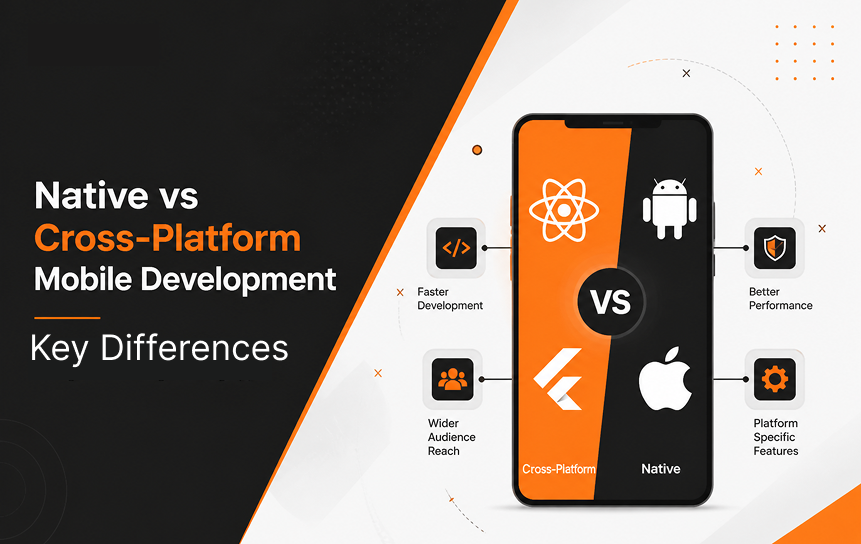
The biggest difference in native vs cross platform mobile development comes down to how applications are built and maintained. Native apps are developed separately for each operating system, while cross platform apps share most of their code across platforms. This affects performance, development speed, costs, user experience, and long-term maintenance. Understanding these differences helps businesses choose an approach that matches their technical requirements, budget, and growth plans.
Performance
Performance is one of the strongest arguments for native development. Native apps communicate directly with the operating system and hardware, which reduces processing overhead and improves responsiveness. This is especially noticeable in graphics-intensive applications, games, video editing software, and apps that rely on real-time data processing.
Cross platform frameworks have improved dramatically over the last few years. Flutter compiles directly to native machine code, while react native continues to improve its architecture for better rendering performance. For many business applications, users may not notice any meaningful difference between the two approaches.
If an app requires advanced animations, intensive background processing, or heavy use of device hardware, native development usually remains the better choice. For standard business applications, cross platform performance is often more than sufficient.
Development Speed
Cross platform development generally reaches the market faster because developers maintain a single primary codebase instead of two separate ones. When comparing native vs cross platform performance, businesses should consider how quickly an app can be developed while still providing a smooth and reliable user experience.
A shared codebase allows teams to:
- Build features once for multiple platforms.
- Fix bugs in one place.
- Release updates simultaneously.
- Reduce duplicated development work.
Native development takes longer because Android and iOS versions are created independently. Even when both apps offer identical functionality, developers must write platform-specific code and perform separate testing. The choice between native vs cross platform scalability also depends on how easily an app can grow, handle more users, and support future updates.
For startups trying to validate an idea quickly, the shorter development timeline offered by cross platform development can provide a significant competitive advantage.
Development Cost
Budget is often one of the first considerations when comparing native vs cross platform mobile app development. The choice between these approaches can have a major impact on overall expenses, especially when evaluating native vs cross platform cost.
Native development usually requires:
- Separate Android developers
- Separate iOS developers
- Additional quality assurance testing
- Independent maintenance for each platform
These requirements increase both initial investment and long-term operating costs. Cross platform development reduces expenses by allowing one team to maintain most of the application from a shared codebase. Businesses can often deliver Android and iOS apps with fewer developers, making this approach attractive for startups and small businesses.
The total cost still depends on application complexity, integrations, backend infrastructure, and ongoing support, but cross platform projects generally require a lower initial investment.
User Experience (UI/UX)
User experience extends beyond visual design. It includes responsiveness, navigation, accessibility, animations, and how naturally the app behaves on each platform. When comparing cross platform vs native, the user experience is an important factor because each approach offers different levels of customization and platform integration.
Native applications follow Apple’s human interface guidelines and Google’s Material Design standards more closely because they use official interface components. Buttons, menus, gestures, and animations feel familiar to users, providing a consistent and intuitive experience.
In terms of native vs cross platform user experience, cross platform frameworks have become much better at replicating native interfaces. Flutter includes customizable widgets, while React Native uses native UI components wherever possible.
For most users, the experience is excellent. Still, applications with highly customized interfaces or advanced animations often benefit from native development because developers have complete control over every interaction.
Security
Security should always be considered during the planning stage rather than after development begins.
Native applications provide direct access to operating system security features, including:
- Secure storage
- Biometric authentication
- Hardware encryption
- Platform security APIs
- Advanced permission controls
Because native apps interact directly with the operating system, security updates can often be implemented more quickly after new platform releases.
Cross platform applications also support strong security practices, including encrypted communication, secure authentication, and protected local storage. However, some advanced security features may require platform-specific code or additional plugins.
Organizations handling financial records, healthcare information, or sensitive enterprise data often choose native development because of its greater flexibility in implementing advanced security measures.
Scalability
Scalability refers to an application’s ability to support increasing numbers of users, new features, and changing business requirements.
Native development offers excellent scalability because developers have complete control over application architecture. Large engineering teams can optimize each platform independently as the product evolves.
Cross platform development also scales effectively for many commercial applications. Modern frameworks support modular architectures, reusable components, and cloud-based services that simplify long-term growth.
Businesses planning global expansion, large enterprise deployments, or feature-rich consumer platforms should evaluate expected future complexity before deciding which approach best supports their roadmap.
Code Reusability
One of the biggest advantages of cross platform development is code reuse. In many projects, developers can share between 70% and 95% of the application’s code across Android and iOS. This reduces duplicated work and simplifies updates.
Benefits include:
- Faster feature development
- Easier maintenance
- Lower testing effort
- Consistent business logic
- Simultaneous releases
Native development offers little code sharing between mobile platforms, although backend services, APIs, databases, and cloud infrastructure can still be reused.
If reducing duplicate development work is a primary objective, cross platform development clearly has the advantage.
Maintenance
Every mobile application requires ongoing maintenance after launch. Native applications require separate maintenance for each platform because Android and iOS have independent codebases.
Typical maintenance activities include:
- Operating system compatibility updates
- Bug fixes
- Performance optimization
- Security patches
- Feature enhancements
- Third-party library updates
Cross platform development simplifies many of these tasks because developers update one shared codebase instead of maintaining two largely separate applications.
This centralized approach often reduces long-term maintenance costs while making feature releases faster and easier to manage.
Platform Compatibility
Native applications are designed specifically for one operating system, allowing developers to optimize every feature for that environment.
Cross platform applications are intended to run consistently across multiple platforms with minimal changes. This includes Android, iOS, and, in some cases, desktop and web platforms depending on the framework.
For businesses targeting both major mobile operating systems from the beginning, cross platform development offers broader compatibility with less duplicated effort.
Organizations building highly specialized applications for a single platform may gain more value from native development.
Access to Device Features
Modern mobile applications often rely on device hardware, including cameras, GPS, Bluetooth, biometric authentication, sensors, and push notifications. When considering native vs cross platform security, the way each approach handles device features and platform updates can be an important factor.
Native development provides immediate access to newly released operating system APIs and hardware capabilities, allowing developers to build applications with strong platform support.
Cross platform frameworks support most common device features through built-in libraries or plugins. When a framework does not yet support a newly introduced capability, developers may need to write native modules until official support becomes available.
For applications that depend heavily on advanced hardware integration and require strict security controls, native development remains the more flexible option.
Testing and Debugging
Testing ensures applications perform consistently across devices and operating system versions. Native development requires independent testing for Android and iOS because each application has its own implementation.
Cross platform development reduces duplicated testing for shared business logic, although developers still need platform-specific testing to verify user interfaces and hardware interactions.
Modern automated testing tools support both approaches, making it easier to identify bugs before release.
Regardless of development strategy, comprehensive testing remains essential for delivering reliable mobile applications.
Offline Functionality
Many mobile apps must continue working even when internet connectivity is limited. Native applications generally offer excellent offline capabilities because developers have complete control over local databases, storage systems, caching strategies, and synchronization mechanisms.
Cross platform frameworks also support offline functionality through shared libraries and local storage solutions. For standard business applications, offline performance is usually comparable to native implementations.
Applications that manage large amounts of local data, complex synchronization processes, or intensive offline processing may benefit from the additional flexibility of native development.
Long-Term Support
Choosing a development approach should include long-term planning rather than focusing only on initial launch. Native development benefits from direct support from Apple and Google, ensuring immediate access to operating system improvements and new development tools.
Long-term advantages include:
- Immediate platform updates
- Official SDK support
- Stable development environments
- Predictable compatibility
- Strong ecosystem documentation
Cross platform frameworks also provide long-term value, especially those backed by large technology companies or active open-source communities. When comparing native vs cross platform performance, businesses should consider how each approach handles speed, scalability, and future feature requirements. Before selecting a framework, companies should also evaluate native vs cross platform maintenance factors, including update history, community support, and long-term roadmap to reduce future migration risks.
Native vs Cross Platform: Pros and Cons
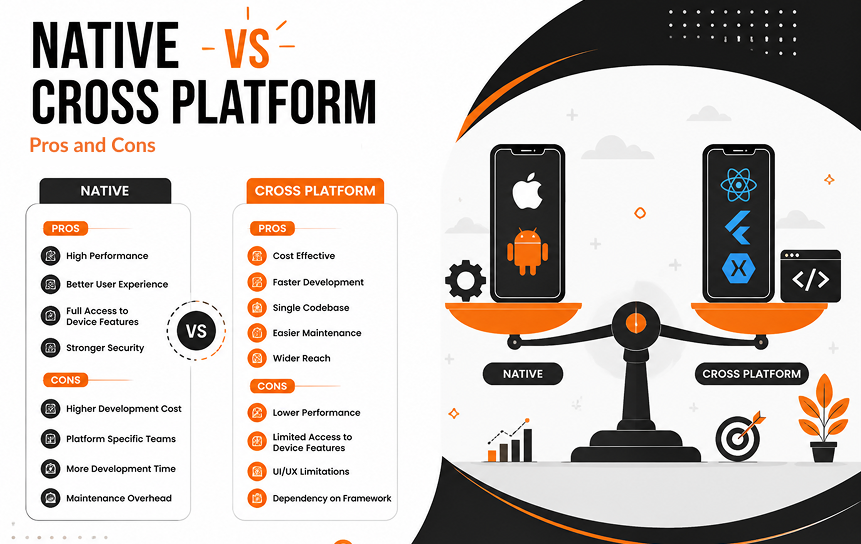
Every project has different priorities. When deciding between cross platform or native, organizations should consider their performance needs, budget, timeline, and long-term goals. Reviewing the native vs cross platform pros and cons of each approach makes it easier to choose the option that aligns with technical requirements and business objectives.
Some organizations value maximum performance, while others need faster development and lower costs. Comparing the strengths and limitations of each approach helps businesses select the right development strategy for their specific needs.
Native Development Pros and Cons
| Pros | Cons |
| Outstanding performance | Higher development cost |
| Excellent user experience | Separate codebases |
| Full hardware access | Longer development time |
| Strong security | Larger development teams |
| Better platform optimization | Higher maintenance effort |
Cross Platform Development Pros and Cons
| Pros | Cons |
| Lower development cost | Slight performance trade-offs |
| Faster development | Limited access to some new platform APIs |
| High code reusability | Framework dependency |
| Easier maintenance | Some features require native modules |
| Simultaneous releases | More optimization for complex apps |
When Should You Choose Native Mobile Development?
Native development is the right choice when performance, security, reliability, or advanced hardware integration cannot be compromised. Although development takes more time and resources, the long-term benefits often justify the investment for demanding applications.
Best for High-Performance Apps
Applications that process large amounts of data or require extremely fast response times benefit from native development.
Examples include:
- Video editing software
- Professional photography apps
- Real-time communication platforms
- Navigation systems
- Streaming applications
- Augmented reality experiences
Direct access to operating system resources helps these applications deliver smoother performance and greater stability.
Best for Enterprise Applications
Native development allows enterprise teams to implement advanced authentication, encryption, device management, and platform-specific integrations without relying heavily on third-party frameworks.
Many enterprise applications also undergo continuous optimization over several years, making the flexibility of native development especially valuable.
Best for Gaming Apps
Mobile games place heavy demands on graphics rendering, memory management, and processor performance. Native development allows developers to optimize graphics pipelines, physics engines, animations, and touch responsiveness for each operating system.
Although some games are successfully built with cross platform technologies, high-end competitive games often achieve better results through native development.
Best for Security-Focused Apps
Applications that manage confidential information should prioritize security from the beginning.
Examples include:
- Banking applications
- Healthcare platforms
- Government software
- Identity verification systems
- Corporate security tools
Native development provides direct access to operating system security features, helping organizations implement stronger protection for sensitive user data.
When Should You Choose Cross Platform Mobile Development?
Cross platform development is a practical option for businesses that want to launch quickly, control costs, and support both Android and iOS from the start. A shared codebase allows development teams to deliver consistent features across platforms while reducing duplicated work.
Best for Startups
Startups often operate with limited budgets and aggressive timelines. Building separate native applications can consume valuable resources before the product has been validated in the market.
Cross platform development allows startups to:
- Reach Android and iOS users simultaneously.
- Reduce initial development costs.
- Release updates faster.
- Gather customer feedback earlier.
- Adjust product features with less effort.
Once the business grows and user requirements become more demanding, specific modules can be optimized or rewritten natively if necessary.
Best for MVP Development
A Minimum Viable Product (MVP) is designed to test an idea with real users before investing heavily in a complete product.
Cross platform development is well suited for MVPs because developers can build one application that serves multiple platforms.
Benefits include:
- Faster validation of business ideas
- Lower financial risk
- Easier feature iteration
- Quicker customer feedback
- Reduced maintenance during early development
This approach helps founders determine product-market fit before expanding the application’s functionality.
Best for Small Businesses
Many small businesses need mobile applications for customer engagement rather than advanced technical capabilities.
Examples include:
- Restaurant ordering apps
- Appointment booking systems
- Fitness applications
- Educational platforms
- Local service marketplaces
- Customer loyalty programs
For these projects, cross platform development provides an excellent balance between affordability, functionality, and long-term maintenance.
Best for Faster Product Launches
Reaching the market quickly can create a competitive advantage. Since developers maintain one primary codebase, new features, bug fixes, and updates can often be released simultaneously across Android and iOS.
This streamlined workflow reduces delays and helps businesses respond more quickly to customer feedback, market trends, and changing business priorities.
Best Cross Platform Mobile Development Frameworks
Modern frameworks have significantly improved performance, developer productivity, and platform compatibility. Each framework has unique strengths, making it important to choose one that aligns with your project’s technical requirements and long-term goals.
Flutter
Flutter, developed by Google, has become one of the most popular cross platform frameworks.
Key strengths include:
- Excellent UI customization
- Fast rendering performance
- Rich widget library
- Strong developer community
- Hot Reload for faster development
- Support for Android, iOS, web, and desktop
Flutter compiles directly into native machine code, helping it achieve performance close to native applications for many use cases.
React Native
React Native, maintained by Meta, allows developers to build mobile applications using JavaScript and React.
Advantages include:
- Large developer community
- Extensive third-party ecosystem
- Native UI components
- Faster onboarding for web developers
- Good performance for business applications
Many organizations choose React Native because existing JavaScript developers can contribute to mobile projects with a shorter learning curve.
Kotlin Multiplatform
Kotlin Multiplatform takes a different approach by allowing developers to share business logic while maintaining native user interfaces.
This model offers:
- Native UI for each platform
- Shared application logic
- Better code organization
- Easier platform customization
- Strong Android ecosystem support
It appeals to teams that want partial code sharing without giving up platform-specific user experiences.
.NET MAUI
.NET MAUI is Microsoft’s modern framework for building cross platform applications.
It supports:
- Android
- iOS
- Windows
- macOS
Organizations already using the Microsoft ecosystem often choose .NET MAUI because it integrates well with existing .NET applications, development tools, and enterprise infrastructure.
Ionic
Ionic focuses on web technologies such as HTML, CSS, and JavaScript.
Its strengths include:
- Rapid application development
- Familiar web development workflow
- Progressive Web App (PWA) support
- Large plugin ecosystem
- Good choice for content-driven applications
Although it may not deliver the same performance as Flutter or native development for demanding applications, Ionic remains a practical solution for many business projects.
Native vs Cross Platform: Real-World Examples
Looking at real applications demonstrates that both approaches are capable of supporting successful products. The right choice depends more on business requirements than on popularity.
Apps Built with Native Development
Many of the world’s most demanding mobile applications rely on native development because they require maximum performance and deep operating system integration.
Examples include:
- Banking applications with advanced security
- High-end mobile games
- Professional camera applications
- Video editing software
- Navigation and mapping apps
- Healthcare platforms handling sensitive medical information
These applications frequently use advanced graphics, biometric authentication, background processing, or specialized hardware features. Native development gives engineering teams complete control over optimization, allowing them to deliver responsive user experiences while maintaining high reliability and security standards.
Apps Built with Cross Platform Frameworks
Cross platform frameworks power thousands of successful commercial applications across multiple industries.
Common examples include:
- E-commerce platforms
- Food delivery services
- Customer loyalty applications
- Internal business tools
- Educational platforms
- Event management apps
- Booking systems
- Content publishing applications
These applications benefit from shared codebases, allowing businesses to reduce development costs while delivering consistent functionality across Android and iOS. Modern frameworks provide performance that is more than adequate for the majority of customer-facing business applications.
Native vs Cross Platform Mobile Development: Decision Matrix
There is no universal answer to the native vs cross platform mobile development debate. The best option depends on your priorities, technical requirements, budget, and long-term business strategy.
If Performance Is Your Priority
Choose native development if your application depends on:
- High frame rates
- Advanced graphics
- Real-time processing
- Complex animations
- Intensive hardware access
- Low latency
These requirements are common in gaming, augmented reality, financial trading, media production, and enterprise software where performance directly affects user satisfaction.
If Budget Is Limited
Native vs cross platform app development decisions are often influenced by budget considerations. Cross platform development is usually the better option when controlling costs is the primary objective.
A shared codebase reduces:
- Development expenses
- Maintenance costs
- Team size
- Testing effort
- Time spent implementing duplicate features
This makes cross platform development especially attractive for startups, nonprofit organizations, and small businesses.
If Time to Market Matters
Native vs cross platform development time is another important factor when choosing an approach. Launching quickly allows businesses to gather customer feedback, generate revenue, and improve products sooner.
Cross platform development supports faster releases because developers maintain one primary codebase instead of separate Android and iOS projects. For businesses entering competitive markets, this shorter development cycle can become a meaningful business advantage.
If Long-Term Scalability Matters
Applications expected to grow significantly over several years should prioritize long-term flexibility. Native development often provides greater architectural freedom for:
- Large engineering teams
- Enterprise-scale applications
- Continuous optimization
- Platform-specific innovation
- Advanced hardware integration
Businesses planning complex mobile ecosystems may find that native development better supports future expansion.
Common Mistakes to Avoid When Choosing Between Native and Cross Platform
Many organizations focus only on development cost without considering future maintenance, scalability, and business growth.
Common mistakes include:
- Ignoring long-term maintenance costs.
- Choosing technology based only on trends.
- Underestimating security requirements.
- Overlooking future scalability.
- Selecting a framework without evaluating community support.
- Assuming every app requires maximum performance.
- Failing to define clear business objectives before development begins.
A thoughtful evaluation of technical and business needs usually leads to a better decision than simply choosing the newest technology.
Future of Mobile App Development in 2026 and Beyond
Mobile development continues to evolve as frameworks become faster, operating systems become more capable, and development tools improve.
Cross platform frameworks are steadily narrowing the performance gap with native applications, while native development continues to offer unmatched optimization and immediate access to new platform features.
Artificial intelligence, on-device machine learning, stronger privacy protections, and improved cloud integration are expected to shape the next generation of mobile applications. Development teams will increasingly choose technologies based on specific business requirements rather than following a single development trend.
Final Verdict
The choice between native vs cross platform mobile development depends on what your application needs to achieve. Selecting the right native or cross platform for mobile app development approach requires considering factors such as performance, budget, timeline, and long-term goals.
Native development remains the preferred option for projects that demand outstanding performance, platform-specific user experiences, advanced security, and unrestricted access to device hardware. It is often the best fit for enterprise software, financial applications, healthcare platforms, and high-performance mobile games.
Cross platform development offers excellent value for businesses seeking faster development, lower costs, and easier maintenance. Modern mobile development frameworks such as Flutter, React Native, Kotlin Multiplatform, and .NET MAUI have matured to the point where they can support many commercial applications with impressive performance.
Choosing the best mobile app development approach requires evaluating your budget, development timeline, expected growth, security requirements, and long-term maintenance strategy. Selecting the approach that aligns with your business goals will produce better results than choosing one based solely on popularity.
FAQs
-
What Is Native Mobile App?
A native mobile app is an application built specifically for a single operating system, such as Android or iOS. It uses platform-specific programming languages and tools, allowing developers to achieve better performance, smoother interactions, and deeper access to device features.
-
What Is Native Application Development?
Native application development is the process of creating apps specifically for one mobile platform. Developers use technologies such as Swift and Xcode for iOS applications and Kotlin with Android Studio for Android applications. This approach is often chosen when performance, security, and a platform-specific experience are important.
-
What Is Cross Platform Mobile Development?
Cross platform mobile development is an approach where developers build applications that work on multiple operating systems using a shared codebase. It allows businesses to create Android and iOS apps more efficiently while reducing development time and costs.
-
What Is Cross Platform App Development?
Cross platform app development involves creating mobile applications that run across different platforms using frameworks such as Flutter or React Native. This approach helps teams maintain similar features and functionality across multiple devices without building separate apps from scratch.
-
What Is the Difference Between Native and Cross Platform Development?
The main difference between native and cross platform development is the way applications are created. Native development builds separate apps for each operating system, while cross platform development uses a shared codebase for multiple platforms.
The choice depends on factors such as performance needs, budget, timeline, and project goals. A native vs cross platform mobile development comparison helps businesses understand which approach fits their requirements.
-
Which Is Better: Native or Cross Platform?
There is no single option that works best for every project. Which is better native or cross platform depends on the application’s purpose, required performance, budget, and development goals.
Native development is usually preferred for apps requiring advanced features, maximum performance, or deep hardware integration. Cross platform development is often suitable for businesses looking for faster delivery and reduced costs.
-
What Are the Benefits of Cross Platform App Development?
The benefits of cross platform app development include:
- Faster development time: A shared codebase helps teams build apps for multiple platforms more quickly.
- Lower costs: Businesses can reduce expenses compared to developing separate native applications.
- Simpler maintenance: Updates and bug fixes can be managed more efficiently.
- Consistent user experience: Apps can provide similar functionality across different platforms.
Choosing between approaches depends on factors such as native vs cross platform performance comparison, native vs cross platform cost comparison, and native vs cross platform development time. Businesses should also consider when to choose native development and when to choose cross platform development based on their specific needs.


